Twenty-Eight Minutes
On leaving without a plan, an idea I've carried for fourteen years, and a website that came back to life.
Yesterday, a Webby-nominated website my team built in 2006 came back to life on my laptop in 28 minutes. It had been effectively dead for years, locked inside a technology no modern browser will run. I didn't write a single line of code. Not because I didn’t want to, because I am incapable of it.
I'll tell that story properly in a moment. But it only makes sense in the context of the year I've had. The last time I posted anything on LinkedIn, we were celebrating the launch of HYDR/O at Dr. Diamond’s Metacine. So consider this part career update, part reflection, and part attempt to explain why, at 56, I feel more energized about my work than I have in a very long time.
Leaving Without a Plan
On January 1, 2026, I stepped away from my role as President of Dr. Diamond's Metacine. I didn't have the next thing lined up.
I'm not holding that up as career advice. Most people would tell you to secure your next move before leaving the current one, and most of the time they'd be right. But it's a pattern I've come to recognize in myself. I left Origins in 2016 without a plan, dpHUE in 2020 and as mentioned, Metacine at the beginning of this year.
As Bob Dylan taught me, when something isn’t right, it’s wrong. There isn't much of a middle category for me when it comes to my career. Once I feel that, staying on while I quietly plan my exit feels fake, to me and to the people I'm working with. So I go, and I trust that the next thing will show up.
I’m not saying it isn’t nerve-wracking, risky, maybe even stupid. Actually, that’s exactly what I’m saying, it’s all the above. Don’t do this at home.
From Experimenting to Working Differently
The first thing that showed up was a consulting engagement with Young Goose (a brand I think is the future of skincare, with incredible founders) to build a three-year strategic growth plan. Their podcast Biohacking Beauty is a must-listen if you’re in the industry or a skincare junkie.
I'd been experimenting with AI for a year or two by then, the way a lot of people have: drafting, summarizing, brainstorming. It was useful and occasionally impressive, but peripheral to the real work.
Young Goose was where that changed. I used AI to get organized, then for financial modeling and forecasting, and something started shifting. For the first time it felt less like a clever tool and more like a capable analyst sitting beside me. I could test an assumption, see its consequences, and move to the next question in minutes. I started rethinking how much ground one experienced person could cover. The plan deliverable, I felt, was some of the best work I’d ever done.
In May, I was beyond fortunate to join the brilliant founder Merian Odesho and her brand Bounce Curl as President. I kept folding AI into my daily routine, as a researcher, advisor, editor.
Then, about three weeks ago, the nature of it all changed. I began working with an instance of Claude connected directly to Bounce Curl's technology stack. Until then, AI had been a thinking partner that knew only what I told it. Now it could work with our actual business information and systems.
In the past three weeks, I've used it to build demand plans and sales forecasts, audit our paid media and email marketing, develop strategic action plans, write creative briefs for my team, redesign our KPI frameworks, and identify operational and supply chain efficiencies.
These are analyses, plans, audits, and frameworks. Implementation is underway, and the measurable results are still ahead of us. I'm not reporting business results. We are just getting started.
What I can report is that the way I work has changed. I'm not using AI to write faster or automate busywork. I'm using it to connect financial, operational, marketing, and consumer data in a single line of reasoning, so my decisions are better informed. The distance from a question to a plan is now measured in hours rather than weeks, months, even years.
An Idea I've Carried Since 2012
There's a reason this hit me so hard, and it goes back over 14 years.
In May 2012, I began a role leading Consumer Engagement at Origins, part of the Estée Lauder Companies. I developed a vision for omnichannel customer experience. The idea was simple to describe and very hard to do: connect consumer data across every channel and touchpoint, understand the real economics of each individual consumer relationship, and use that intelligence to drive investment decisions, personalization, loyalty, retention, and marketing strategy.
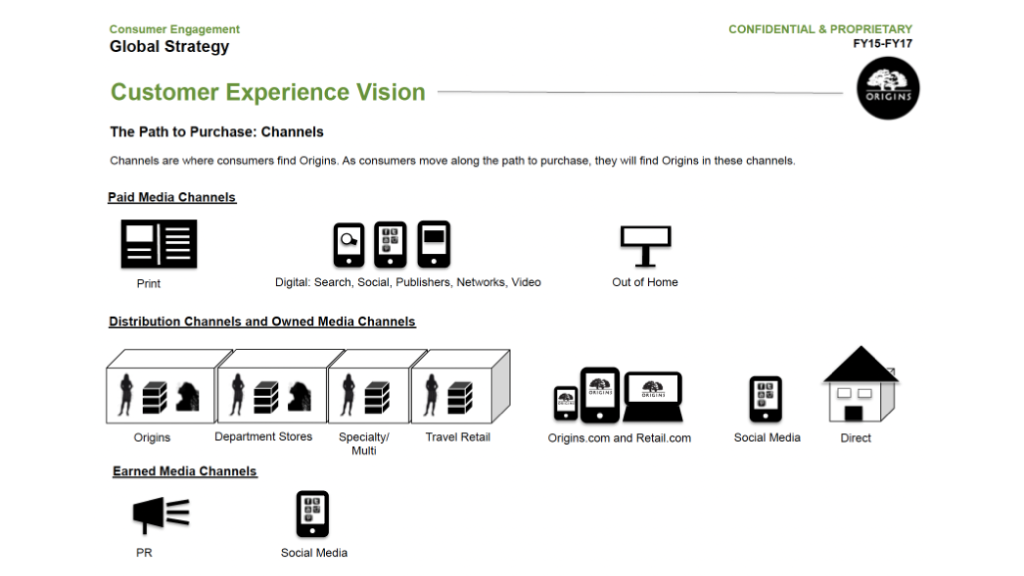
The idea was right. But even inside one of the largest beauty companies in the world, aside from the infrastructure, budget, and organizational alignment required, the technology was just not there.
I've carried it with me through every role since, trying to connect these dots, asking people smarter than me to parse data across platforms, trying to brute-force data homogenization. Over the past three weeks, I've had the strange experience of watching a lot of it become practical. The barrier was never the thinking. The barrier was technology, and the cost of turning thinking into analysis and action. That cost is falling faster than (to quote another favorite, Jay Farrar and Son Volt) a ten-second buzz.
Twenty-Eight Minutes
Which brings me to yesterday.
I've recently been revisiting a family history research project I started several years ago, and I'd begun wondering whether I could use AI to turn that research into an interactive website. That made me think of an interface my old agency, Freedom Interactive Design, had designed around 2007 for the actor Walter Matthau. So I went digging through old files on my computer looking for it.
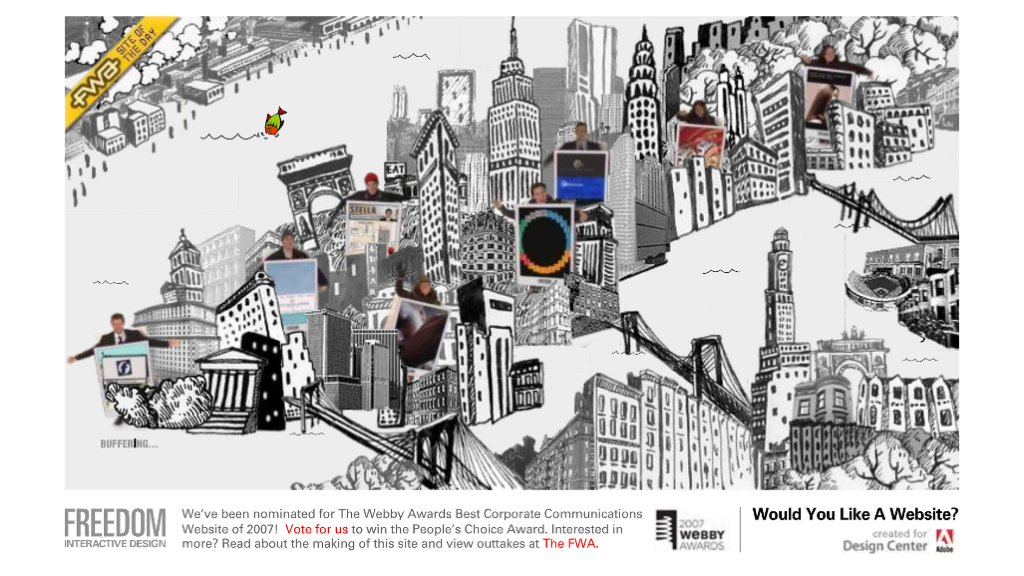
I found it. But I also found a folder containing the original source files for Would You Like a Website?, an ambitious Flash-based interactive site we created in 2006.
That project meant a great deal to us. In 2007 it was nominated for a Webby Award in the Corporate Communications category, alongside Adobe's corporate site, Kellogg’s 100th-anniversary site, and MGM Grand Hotel & Casino, which took the award. For a small independent agency, being in that company was both a thrill and validating.
But Flash has been dead for years, and the site went with it. I hadn't been able to experience it in a modern browser in a very long time. It existed only as a folder of files I couldn't open and a memory of how it felt.
So, on a whim, I connected Claude to that folder on my desktop. I didn't prepare the files, extract assets, write code, or give technical instructions. I asked one question:
"Can you help me view this without Flash?"
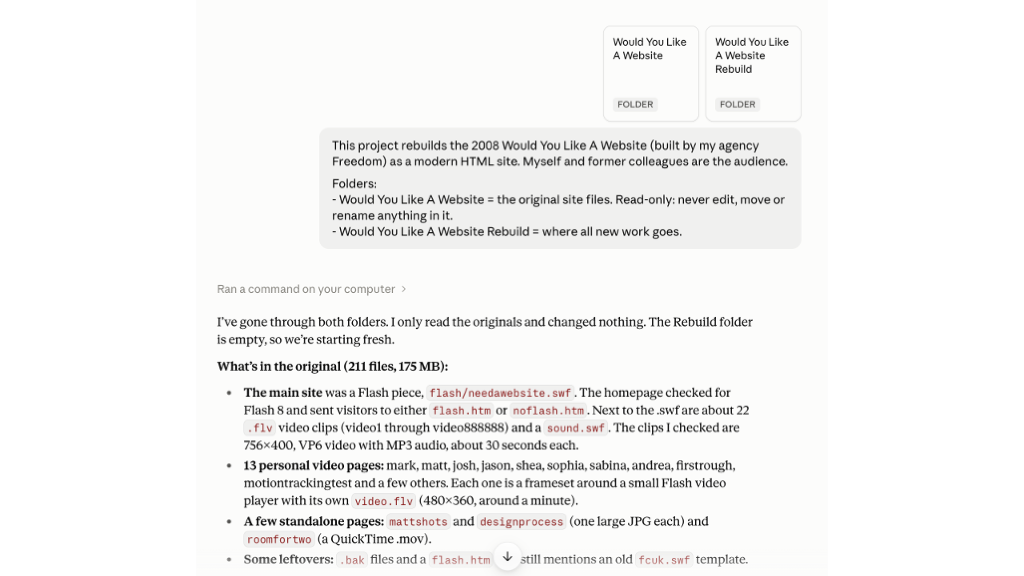
Twenty-eight minutes later, I was looking at the entire website, rebuilt in modern HTML. The animations, the interactions, and the personality my team worked so hard on were virtually identical to the original. By my estimate, it's about 99 percent faithful to what we built twenty years ago.
I sat there clicking through it for a long time. It's hard to describe what it's like to see work you made with people you cared about, from a chapter of your life you remember vividly, suddenly breathing again. It felt like magic. It also felt a little like time travel.
You can experience it yourself here: wouldyoulikeawebsite.com.
What I Think This Actually Means
It would be easy to turn this into a story about how astonishing AI is, and it is astonishing. But that isn't the part I keep thinking about.
I've spent nearly thirty years working through technological transitions: the early interactive web, e-commerce, social media, mobile, omnichannel marketing, data-driven consumer engagement. Each one was exciting, and each changed how brands and consumers find each other. But I haven't felt this particular mix of curiosity, excitement, and creative possibility since the very beginning, when Bill Clinton was in office.
What's different is where the leverage sits. The restoration took twenty-eight minutes because the technical work, which once would have taken a developer days, weeks or months, is now a matter of minutes. But knowing the site was worth saving, knowing what it was supposed to feel like, and knowing whether the result was right came from me and from the people who built it with me.
The same is true at Bounce Curl. AI can build a forecast in minutes. Knowing which questions to ask, what good looks like, and how consumer behavior, brand strategy, technology, and financial performance connect is still the hard part. That part is built out of decades of experience.
So this isn't a story about AI replacing people. For me, it's closer to the opposite. I don't feel my experience becoming less valuable. I feel it becoming far more useful, because the distance between having an idea and bringing it to life is shrinking dramatically.
In 2006, my team was exploring what was possible with an emerging technology. From 2012-2016 at Lauder, I was imagining what might be possible if we could truly connect consumer data, engagement, and financial performance. In 2026, I'm finding that many of the barriers between imagining something and making it are disappearing.
Looking Back, Looking Forward
I started by looking into my family's past. That sent me searching for an old design from my own past, which led me to a website from an earlier chapter of my career.
I’m looking backward and discovering what lies ahead at the same time.
At 56, nearly 30 years into my career, I feel as energized as I felt when I discovered the Internet, learned what a “pro forma” was, wrote the business plan for Firstborn Multimedia and moved to NYC.
I can’t wait to see where things stand 3 weeks from now.